Category: Craft & Discipline

  • Why Ironwood Exists (And Why It Started With a Heart)

    For a long time, Ironwood Collective existed quietly.

    There was no name for it yet. No website, no logo, no plan to share it publicly. It was just me, a workbench, a pile of wood, and tools slowly shaping pieces one at a time.

    “That’s really where Ironwood began — not as a brand, but as a practice.”

    What started it wasn’t a business idea.

    It was the need to steady my mind.

    When life becomes chaotic or overwhelming, the nervous system looks for something predictable—something rhythmic, something that can pull your attention back into the present moment. I didn’t sit down and analyze that at the time. I just noticed that when I was working with my hands, things inside me became calmer.

    Carving wood demands focus. You have to pay attention to the grain, the direction of your cuts, the pressure of the tool. If your mind wanders too far, the wood reminds you quickly.

    So the work naturally becomes repetitive.

    Cut. Shape. Sand. Refine.

    Again and again.

    And that repetition started doing something important for me. It created a kind of emotional regulation without needing to think about it too much. The rhythm of the work kept my mind steady.

    That’s really where Ironwood began.

    Not as a brand.

    As a practice.

    Why Hearts

    The very first shape I chose to carve was a heart.

    There was no complicated reasoning behind it. I chose a heart because it has always been my mom’s favorite shape. She has loved hearts for as long as I can remember—little ones, big ones, carved ones, painted ones. Hearts show up everywhere in her world.

    So when I started carving, the first object I made was a heart.

    And the first heart I ever finished went straight to her.

    That piece was simple. Rough compared to the ones I make now. But it carried something important inside it—the beginning of a process that would grow into Ironwood Collective.

    Over time, I kept making them.

    Not because I was trying to build a product line. I kept making them because the shape itself felt right. A heart is recognizable in every culture. It represents connection, care, and the things that matter most to people.

    But more practically, the shape also works beautifully in the hand.

    When a wooden heart is carved well, it settles naturally into the palm. Your thumb can move along the curve. The weight feels balanced. The edges soften through sanding until the piece feels warm and smooth.

    That tactile experience became just as important as the shape itself.

    The hearts weren’t just objects.

    They became something to hold.

    “Strong things grow slowly.”

    The Process That Built Ironwood

    As I kept carving, I began noticing something about the process itself. There was a pattern to it that extended beyond woodworking.

    Every piece followed the same three truths.

    First, there was structure.

    You can’t start carving randomly. The wood has to be prepared. The block has to be cut to size. The shape has to be marked. The tools have to be sharp.

    The process has a structure for a reason—it prevents chaos.

    Second, there was effort.

    Not rushed effort. Not dramatic effort.

    Just sustained work.

    Sanding hardwood can take a long time. Shaping curves requires patience. Some pieces cooperate easily, and others resist every tool you bring near them.

    But if you keep working, the piece slowly begins to emerge.

    Third, there was achievement.

    When you finally hold the finished piece in your hand, it feels different. Not just physically smoother, but meaningful in a deeper way.

    You remember what it took to create it.

    The adjustments. The patience. The hours of quiet effort.

    That feeling cannot be rushed or manufactured.

    It has to be earned.

    Eventually I realized those three ideas perfectly described the process that was unfolding in front of me.

    Structured Craft. Sustained Effort. Earned Achievement.

    That phrase wasn’t written as a marketing line. It simply captured the truth of what the work was teaching me.

    Why Share It Now

    For a long time, these pieces stayed close to home.

    Some sat on my desk. Some were carried in my pocket throughout the day. Others were given to a few people close to me.

    But as Ironwood slowly grew, something became clear.

    The value of this work isn’t just in the objects themselves. It’s in the experience of slowing down and making something real with your hands.

    In a world that constantly pushes speed, efficiency, and instant results, craft asks for the opposite. It asks for patience. It asks you to focus on a single step at a time.

    And when you finish, you’re left holding something tangible that reminds you what steady effort can create.

    That’s why Ironwood Collective is being shared now.

    The carved hearts are the beginning. They are small objects, but they carry a process inside them—a process of repetition, patience, and care.

    Each one is shaped slowly by hand. No two are identical because the wood itself is never identical. The grain changes, the density changes, the character of the piece changes.

    The work adapts to the material.

    Just like people adapt to the experiences that shape them.

    The Meaning Behind Ironwood

    Ironwood is one of the strongest woods in the world. It grows slowly, becoming incredibly dense and resilient over time. Its strength doesn’t come from speed—it comes from years of steady growth.

    That idea felt right.

    Ironwood Collective is built around the same principle.

    Strong things grow slowly.

    The hearts that started this work represent that idea in the simplest possible way. They are carved through repetition, shaped through patience, and finished through sustained effort.

    And the very first one—the one that began it all—went to the person who unknowingly inspired the shape from the beginning.

    My mom.

    Ironwood may grow into many things over time—objects, classes, shared learning, and community—but it started with something very simple.

    A block of wood.

    A quiet workbench.

    And a heart carved slowly, one stroke at a time.
  • The Forgiveness Of Wood

    There is something steady about working with wood that most people don’t notice until they make a mistake.

    You measure wrong.

    You cut too deep.

    You round an edge you meant to keep sharp.

    And for a moment, you feel it—the tightening in your chest. The instinct to start over. The frustration of imperfection.

    But wood does something unexpected.

    It allows adjustment.

    Unlike metal or glass, wood is not absolute. It does not shatter because you misjudged by a fraction. It does not reject you for shaving too much from one side. It simply presents a new set of possibilities. The shape changes. The plan shifts. The object begins to become something slightly different than what you first imagined.

    And if you pay attention, the wood will guide you.

    Grain direction matters. Density matters. Knots interrupt symmetry. A cut that feels wrong in one direction may reveal a curve that feels intentional when viewed from another angle. The material itself begins to inform the next move.

    This is not romanticism. It is practical physics.

    Wood fibers compress. They respond to pressure. They carry memory of growth rings and environmental stress. They are flexible without being weak. When you carve or shape wood, you are not imposing form onto something lifeless. You are collaborating with a material that already contains structure.

    A wrong cut rarely ruins a piece. It redirects it.

    If you shave too much from one side of a heart, the proportions adjust. The curve becomes softer. The edge becomes more subtle. If a figurine’s ear becomes too thin, it may become a different animal entirely. If a board splits, it might become two smaller, more refined objects instead of one large one.

    Beginners assume precision is everything.

    Experienced makers understand that responsiveness is more important.

    There is a discipline in continuing forward instead of discarding.

    In structured handcraft, mistakes are data. They reveal grain direction. They reveal tool control. They reveal where your pressure was uneven. And once you see it, you adjust. You learn. You take the next shaving more deliberately.

    Wood does not punish you for being imperfect. It requires you to adapt.

    That is a meaningful distinction.

    When you work slowly—measured strokes, consistent repetition—you begin to trust that even missteps can be integrated. The process does not collapse because of one error. In fact, some of the most balanced forms emerge because the original plan had to change.

    A perfectly executed piece feels controlled.

    A redirected piece feels alive.

    There is also humility in this. Wood reminds you that you are not in total control. Grain can tear out. Density can shift mid-cut. A hidden knot can appear exactly where you didn’t want it. You learn to look closer. You learn to cut with the grain instead of against it. You learn to pause before forcing a blade through resistance.

    Force rarely improves the outcome. Attention does.

    This is part of why structured repetition matters in craft. When you carve enough hearts, enough small animals, enough simple forms, you stop panicking at imperfection. Your hands recognize that shape is adjustable. You know instinctively how much material can be removed before structural integrity is compromised. You develop judgment.

    And judgment builds confidence.

    Not because you never make mistakes, but because you know you can recover from them.

    Wood forgives, but it also teaches.

    If you over-sand one side, you learn balance.

    If you rush and create uneven lines, you learn pacing.

    If you push too hard and chip an edge, you learn restraint.

    The material reflects your behavior back to you without emotion, without criticism. It simply shows you the result.

    And then it allows you to continue.

    There is something stabilizing about that.

    In a world that often feels rigid and unforgiving, working with a material that accommodates correction changes how you approach effort. It encourages persistence. It rewards patience. It makes room for evolution.

    You start with one idea.

    You end with something slightly different.

    And most of the time, it is better.

    Not because it was perfect.

    But because you stayed with it long enough to let the wood lead.

  • Why Routine and Structure Matter for the Brain

    Structure is often misunderstood as rigidity. Routine is often dismissed as boring. In reality, both are neurological stabilizers.

    The human brain is an energy-conserving organ. Although it represents only about two percent of body weight, it consumes roughly twenty percent of the body’s energy.

    To function efficiently, it relies heavily on prediction. When the brain can anticipate what happens next, it uses fewer metabolic resources to manage uncertainty.

    The human brain is an energy-conserving organ. Although it represents only about two percent of body weight, it consumes roughly twenty percent of the body’s energy. To function efficiently, it relies heavily on prediction. When the brain can anticipate what happens next, it uses fewer metabolic resources to manage uncertainty.

    Routine creates predictability. Predictability lowers cognitive strain.

    From a neuroscience perspective, the brain is constantly scanning for threat or novelty. The amygdala plays a central role in detecting potential danger, while the prefrontal cortex is responsible for higher-order reasoning, planning, and impulse control. When environments feel chaotic or unpredictable, the amygdala increases activation. This can suppress optimal prefrontal functioning.

    In simple terms: when your brain feels uncertain, your thinking narrows.

    Structure reduces that baseline uncertainty. When daily rhythms are predictable, the nervous system interprets the environment as safer. Safety signals allow the prefrontal cortex to function more efficiently. Decision-making improves. Emotional reactivity decreases. Attention stabilizes.

    This is not philosophical. It is biological.

    Routine and Cognitive Load

    Cognitive load theory explains that working memory has limited capacity. Every decision—small or large—occupies mental space. In environments without structure, individuals make hundreds of micro-decisions daily: when to begin tasks, what to prioritize, how to sequence responsibilities.

    Each decision consumes cognitive resources.

    When certain aspects of life become routinized, the brain automates them through habit loops. The basal ganglia, a subcortical structure involved in procedural learning, plays a key role here. Once behaviors become habitual, they require significantly less conscious effort.

    This frees up working memory for higher-level problem solving.

    The psychological effect is subtle but powerful. Mental clarity improves not because intelligence increases, but because mental bandwidth is preserved.

    Routine and Mood Regulation

    Mood is not purely emotional. It is neurochemical.

    Stable routines support consistent sleep patterns, regular nourishment, and predictable activity cycles. These factors influence neurotransmitter regulation, including serotonin and dopamine pathways. Irregular sleep and inconsistent daily rhythms can disrupt these systems, contributing to irritability, low mood, or heightened anxiety.

    Circadian rhythm research supports this directly. The brain operates on internal clocks regulated by light exposure, activity timing, and environmental cues. When daily patterns shift unpredictably, circadian misalignment can occur. Even mild disruption has measurable effects on mood stability and cognitive performance.

    Routine anchors circadian stability.

    There is also a psychological dimension. Predictability enhances perceived control. Perceived control is strongly correlated with resilience and lower stress markers. When individuals feel that aspects of their environment are stable and ordered, stress responses moderate.

    Chronic unpredictability, by contrast, maintains low-level sympathetic activation. Over time, this sustained activation contributes to fatigue and mood volatility.

    Routine does not eliminate stress. It reduces background stress.

    Structure and Emotional Regulation

    Emotional regulation depends partly on predictability. When the brain cannot anticipate what is coming next, it remains in monitoring mode. Monitoring mode increases vigilance. Vigilance narrows cognitive flexibility.

    Structured environments reduce the need for constant monitoring.

    Research in developmental psychology consistently shows that children thrive under consistent structure because it builds secure attachment and emotional stability. Adults are not neurologically different in this respect. The need for predictability does not disappear with age.

    In fact, in high-demand professional environments, structured workflows reduce burnout risk. Burnout is strongly associated with role ambiguity and unpredictability. Clear expectations and consistent systems mitigate this.

    Routine stabilizes not only the individual but also group dynamics.

    Work Performance and Executive Function

    Executive functions—planning, task initiation, impulse control, sustained attention—are directly influenced by environmental structure.

    When external structure exists, internal executive demand decreases. For example, when workflows are standardized, individuals expend less energy determining next steps. This improves efficiency and reduces procrastination driven by overwhelm.

    Behavioral psychology also shows that consistent cues trigger consistent behaviors. In professional contexts, this enhances productivity because task initiation becomes less emotionally dependent.

    Structure reduces friction.

    Additionally, repetition strengthens neural pathways through a process called myelination. Repeated behaviors increase the efficiency of neural transmission. Over time, structured routines improve task fluency and reduce cognitive fatigue.

    In performance-based environments, this translates to greater reliability.

    Routine and Identity Stability

    Identity is shaped by repeated behavior. When routines reflect personal values—consistency, discipline, steadiness—the brain encodes those behaviors as part of self-concept.

    “I am someone who follows through” becomes reinforced through repetition.

    Without structure, behavior becomes more reactive and mood-dependent. This can create inconsistency in self-perception. Inconsistent self-perception increases internal friction.

    Structure supports identity coherence.

    Coherence reduces psychological strain because the brain does not have to reconcile conflicting self-narratives.

    The Paradox of Freedom

    There is a common belief that freedom means lack of structure. Neuroscience suggests the opposite.

    Structure reduces unnecessary decision-making and stabilizes baseline stress levels. When foundational aspects of life are predictable, creative and strategic thinking improve. This is because cognitive resources are not consumed by constant recalibration.

    Routine creates stability. Stability creates capacity.

    Capacity allows for innovation, creativity, and risk-taking without overwhelming the system.

    Conclusion

    Routine and structure are not about control for its own sake. They are regulatory tools embedded in human neurobiology.

    They reduce cognitive load.

    They stabilize mood.

    They improve executive function.

    They enhance work performance.

    They strengthen identity coherence.

    Most importantly, they reduce background uncertainty, allowing the brain to shift from threat monitoring to higher-order reasoning.

    In a world characterized by rapid change and constant stimulation, structure becomes less about restriction and more about neurological sustainability.

    The brain functions best when it knows what to expect.

    Structure provides that expectation.

    And clarity grows from there.

  • Structured Craft as Professional Development: Building Cognitive and Emotional Capacities Through Hands-On Discipline

    Professional environments increasingly demand cognitive endurance, emotional regulation, and adaptive problem-solving. Yet most professional development programs focus on abstract skill acquisition—communication workshops, leadership seminars, productivity frameworks.

    Ironwood Collective approaches development differently: through embodied discipline.

    Structured craft trains multiple executive functions simultaneously. Executive functions—working memory, inhibitory control, and cognitive flexibility—are foundational to professional competence.

    Consider a carving task. The participant must hold procedural steps in working memory, inhibit impulsive movement to maintain precision, and adjust strategy in response to material resistance. These are not artistic exercises. They are executive control exercises.

    Neuroscientific research supports the integration of motor activity and cognitive development. Complex motor tasks stimulate neural networks that overlap with those used in planning and decision-making. The cerebellum, traditionally associated with coordination, is now understood to contribute to cognitive processes including attention and language modulation.

    In other words, disciplined handcraft strengthens cognitive architecture.

    There is also a stress-regulation component directly relevant to workplace performance. Individuals who cannot regulate physiological arousal under pressure experience narrowed cognitive bandwidth. Reaction replaces reasoning.

    Structured craft trains stress tolerance in manageable doses. When a cut goes slightly wrong, the participant must regulate frustration, adjust technique, and proceed. The stakes are contained, but the regulatory skill is real.

    Repeated exposure to manageable frustration builds distress tolerance. Distress tolerance is strongly correlated with resilience in high-demand professions.

    Additionally, the emphasis on completion builds follow-through. Many modern work environments suffer from fragmentation—multiple unfinished projects, constant interruption, shifting priorities. Completing tangible projects retrains the brain to value closure.

    Closure reduces cognitive load. Open loops consume mental resources. Finishing something—even something small—frees bandwidth.

    Ironwood’s method also strengthens sustained attention. In a digital culture dominated by rapid task-switching, sustained focus is increasingly rare. Deep craft requires continuous attention over extended periods. This trains attentional stamina.

    For recruiters and organizational leaders, this matters. Employees who can maintain focus without constant external stimulation are more efficient and less prone to burnout.

    Finally, there is the ethical dimension of earned achievement.

    Ironwood does not reward appearance. It rewards effort and precision. In professional contexts, integrity and reliability are built the same way. When individuals internalize the principle that outcome reflects input, accountability strengthens.

    Structured craft is not a replacement for traditional professional training. It is a foundational discipline that strengthens the cognitive and emotional systems underlying performance.

    It builds steadiness before speed. Regulation before reaction. Completion before expansion.

    In that way, Ironwood Collective operates as both educational environment and capacity-building laboratory.

    The skills developed in the workshop—focus, patience, adaptability, measured risk-taking, cooperative engagement—are directly transferable to leadership, operations, client service, and creative problem-solving roles.

    Hands-on discipline is not nostalgic. It is neurologically strategic.

    And in environments where complexity and uncertainty are constant, steadiness becomes a competitive advantage.

  • Community Without Performance: Building Cooperative Environments That Reduce Threat Response

    Human beings are social, but not all social environments feel safe.

    Many group settings unintentionally activate performance anxiety. Comparison, evaluation, subtle competition, or even well-meaning praise can increase cortisol levels and shift participants into a threat-monitoring state. When the nervous system perceives evaluation, attentional resources are divided between the task and social judgment.

    Ironwood Collective approaches community differently.

    The workshop is structured around parallel effort rather than competitive output. Participants work side-by-side, not against one another. The focus remains on process metrics—precision, steadiness, patience—not aesthetic ranking.

    This design is informed by social neuroscience. Research indicates that cooperative environments increase oxytocin and reduce stress markers when participants perceive psychological safety. Psychological safety, a concept widely studied in organizational research, refers to the belief that one can participate without fear of humiliation or punishment for mistakes.

    Mistakes in craft are inevitable. In competitive environments, they become sources of embarrassment. In cooperative environments, they become neutral data points.

    Ironwood instructors model non-reactivity. Errors are addressed technically, not emotionally. This reduces anticipatory anxiety. Participants begin to associate group presence with stability rather than evaluation.

    The absence of performance pressure allows deeper focus. Cognitive resources that would otherwise monitor comparison are redirected to skill acquisition.

    There is also an important identity component. In performance-based cultures, worth is often tied to visible output. When community shifts emphasis toward sustained effort instead of final product, value becomes process-based rather than outcome-based.

    This distinction matters.

    Effort-based identity is more resilient than outcome-based identity. Outcomes fluctuate. Effort is controllable.

    Participants learn to observe others’ progress without internalizing comparison as threat. Over time, this reduces social hypervigilance. The nervous system learns that proximity to others does not automatically require defensive posture.

    Community, then, becomes stabilizing rather than draining.

    For professionals and recruiters observing Ironwood’s model, this approach mirrors high-functioning team dynamics. Effective teams are not built on internal competition; they are built on clarity of role, shared process, and psychological safety.

    The workshop becomes a microcosm of healthy collaboration.

    Community without performance does not mean absence of standards. Standards remain high. Precision matters. Completion matters. But evaluation is technical, not personal.

    This distinction reduces shame and increases growth.

    In a culture saturated with metrics, visibility, and social comparison, structured cooperative craft offers an alternative model: collective steadiness without hierarchy of worth.

    That model is transferable well beyond the workshop.

  • Embodied Achievement and Identity Reconstruction: How Tangible Work Rewrites Self-Concept

    Identity is not built through affirmation. It is built through evidence.

    At Ironwood Collective, one of the most important lessons is not about wood, tools, or paint. It is about reconstruction—specifically, how completing tangible work reshapes the way a person understands themselves.

    Psychologically, identity develops through narrative integration. We construct stories about who we are based on memory, feedback, and repeated experience. If someone repeatedly experiences interruption, instability, or unfinished effort, the internal narrative may quietly shift toward: “I don’t finish things,” or “I am inconsistent,” or “I am not capable.”

    These narratives rarely form dramatically. They accumulate subtly.

    Structured handcraft interrupts that accumulation.

    When a participant begins with raw material and moves step-by-step toward completion, something measurable occurs. The brain encodes not just the finished object but the entire sequence: preparation, effort, adjustment, persistence, completion.

    This is significant neurologically. Repeated task completion activates reward circuitry involving dopamine pathways in the mesolimbic system. But more importantly, it strengthens procedural memory networks in the basal ganglia. The brain begins recognizing completion as a repeatable behavior, not a rare event.

    Embodied achievement carries more weight than abstract success because it is sensory. You can hold it. You can see it. You can feel the edges that were once rough and are now smooth. Sensory memory is powerful. It is harder to dismiss.

    There is also a corrective psychological component. Individuals who have experienced prolonged stress or environments where outcomes felt unpredictable often internalize a diminished sense of agency. Agency is the belief that one’s actions influence results. Without agency, motivation declines.

    Craft restores agency in controlled increments.

    The material responds to pressure and technique, not personality. It does not react emotionally. It does not escalate. It responds to input. That consistency is stabilizing. Over time, the participant begins to internalize a new narrative: “When I apply steady effort, the outcome changes.”

    That is identity reconstruction in action.

    Importantly, Ironwood intentionally scopes projects so they can be completed. This is not accidental. In cognitive-behavioral science, mastery experiences are the most powerful contributors to self-efficacy. Self-efficacy does not come from encouragement. It comes from evidence.

    When someone completes one project, then another, and then another, the evidence accumulates.

    The shift is quiet but measurable. Language changes. Posture changes. Hesitation decreases. Individuals begin approaching complexity differently because they have proof of their capacity to persist.

    This is not therapy in the clinical sense. It is structured skill-building that produces psychological impact through embodied evidence.

    Identity is often treated as something to discover. At Ironwood, identity is treated as something built through repetition and completion.

    You do not tell yourself you are capable. You demonstrate it repeatedly until the statement becomes fact.

  • From Chaos to Order: Why Physical Organization Reduces Cognitive Load

    The workshop itself is part of the curriculum. Tools have designated spaces. Materials are measured. Processes follow sequence.

    Environmental psychology shows that clutter increases cognitive load. Visual disorganization competes for attentional resources. Structured environments reduce mental strain.

    At Ironwood, participants learn to prepare their workspace before beginning. Preparation is not cosmetic. It is neurological. A clear workspace reduces competing stimuli, allowing the brain to allocate resources to task execution.

    Order in the environment models order in process.

    Participants often report that adopting small organizational habits outside the workshop—clearing a desk, laying out tools before beginning—reduces overwhelm.

    Structure becomes transferable.

  • Mistakes as Feedback: Teaching Cognitive Flexibility Through Craft

    Perfectionism and avoidance often share the same root: fear of error.

    Craft dismantles that fear through inevitability. Mistakes happen. Grain shifts. Paint drips. Measurements misalign. The difference at Ironwood is that errors are reframed as information.

    Cognitive flexibility—the ability to adjust thinking and behavior in response to new information—is a core resilience skill. In craft, adjustment is constant. If a cut is slightly off, the next step compensates. If a brush stroke overextends, layering corrects it.

    Participants learn that imperfection does not invalidate effort. It requires recalibration.

    This lesson extends beyond the workshop. Individuals begin internalizing that deviation is not disaster. It is data.

    Behavioral science supports incremental exposure to manageable error as a method for reducing avoidance behaviors. Over time, tolerance for imperfection increases.

    Ironwood treats mistakes as neutral.

    That neutrality builds confidence.

  • Painting as a Structured Sensory Alternative

    Not all regulation requires wood. Painting offers a parallel pathway when structured intentionally.

    The key difference between recreational painting and Ironwood-style painting is structure. Participants are guided through deliberate brush control exercises, stroke repetition, and color layering techniques that emphasize precision over expression.

    The brush becomes a metronome.

    Slow, controlled strokes train motor steadiness and visual tracking. The repetitive movement of loading, pressing, lifting, and resetting builds rhythm. Rhythm stabilizes the nervous system.

    Color theory also engages cognitive processing. Selecting complementary tones and understanding contrast activates analytical thinking alongside sensory experience. This integration strengthens bilateral brain coordination.

    Painting provides visual reward more quickly than carving. This can be useful for individuals who benefit from shorter reinforcement cycles. The visible accumulation of layered strokes reinforces persistence.

    As with woodworking, the emphasis is on earned progress, not artistic identity.

    Painting, when structured, becomes another method of embodied focus.

    Painting as a Structured Sensory Alternative

    Not all regulation requires wood. Painting offers a parallel pathway when structured intentionally.

    The key difference between recreational painting and Ironwood-style painting is structure. Participants are guided through deliberate brush control exercises, stroke repetition, and color layering techniques that emphasize precision over expression.

    The brush becomes a metronome.

    Slow, controlled strokes train motor steadiness and visual tracking. The repetitive movement of loading, pressing, lifting, and resetting builds rhythm. Rhythm stabilizes the nervous system.

    Color theory also engages cognitive processing. Selecting complementary tones and understanding contrast activates analytical thinking alongside sensory experience. This integration strengthens bilateral brain coordination.

    Painting provides visual reward more quickly than carving. This can be useful for individuals who benefit from shorter reinforcement cycles. The visible accumulation of layered strokes reinforces persistence.

    As with woodworking, the emphasis is on earned progress, not artistic identity.

    Painting, when structured, becomes another method of embodied focus.

  • Tactile Input and Emotional Regulation

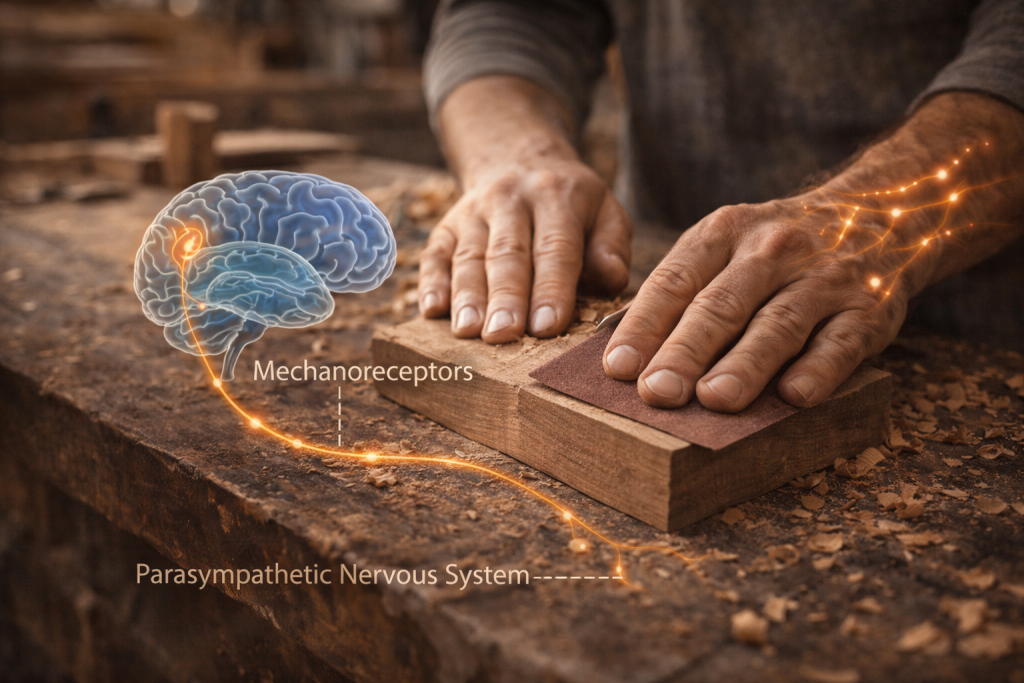
    The skin is the body’s largest sensory organ. Mechanoreceptors embedded in the skin respond to pressure, vibration, and texture. These receptors transmit signals through the spinal cord to the brain, influencing emotional and physiological states.

    Slow, consistent tactile engagement—such as sanding wood or shaping clay—can stimulate pathways associated with parasympathetic activation. This shift promotes slower heart rate, steadier breathing, and decreased muscle tension.

    Research in somatic psychology suggests that bottom-up regulation (body-to-brain signaling) can be more effective in acute stress states than purely cognitive reframing. In other words, changing thought patterns is difficult when the nervous system is dysregulated. Sensory input provides an alternative pathway.

    At Ironwood, tactile experience is intentional. Participants work with raw materials that provide resistance. Resistance requires pressure modulation. Pressure modulation requires awareness.

    This awareness anchors attention to the present moment.

    Tactile regulation also enhances interoception—the ability to perceive internal bodily states. Increased interoceptive awareness correlates with improved emotional regulation and decision-making.

    Working with the hands becomes a training ground for emotional steadiness.