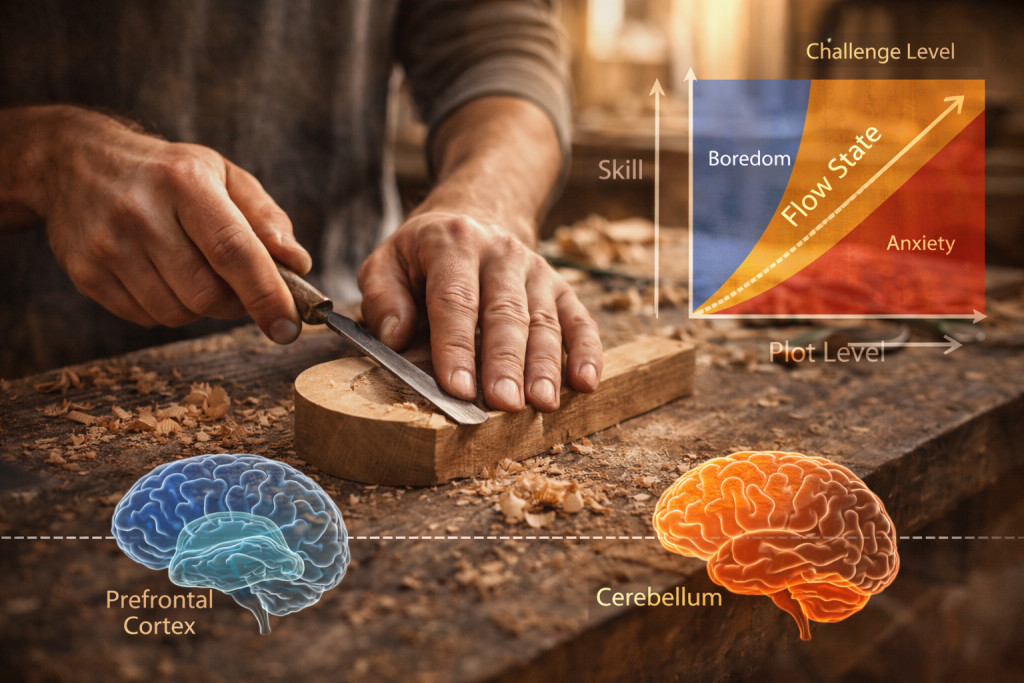
The concept of flow, described by psychologist Mihaly Csikszentmihalyi, refers to a state of deep immersion where skill and challenge are balanced. Time perception shifts. Self-consciousness decreases. Productivity increases.
Structured handcraft is particularly effective at inducing flow because it requires sustained attention, fine motor coordination, and real-time problem solving. When carving, for example, the brain tracks grain direction, pressure modulation, and micro-adjustments. This level of engagement narrows attentional bandwidth to the task at hand.
Functional MRI studies show that during flow states, activity in the medial prefrontal cortex decreases—a phenomenon called transient hypofrontality. This reduction corresponds with reduced self-criticism and internal narrative. Individuals often report feeling “outside their head.”
Ironwood teaches participants how to enter flow intentionally by calibrating challenge. Tasks are scaled to match skill level. Too simple, and attention drifts. Too complex, and anxiety rises. The instructor’s role is to adjust complexity so engagement remains steady.
Flow is not escapism. It is disciplined immersion.
Repeated experiences of flow strengthen attentional control. In a culture dominated by digital fragmentation, sustained focus is increasingly rare and increasingly valuable. Individuals who can regulate attention and persist through complexity are more adaptable in professional and personal environments.
Ironwood treats focus as a trainable capacity, not a personality trait.
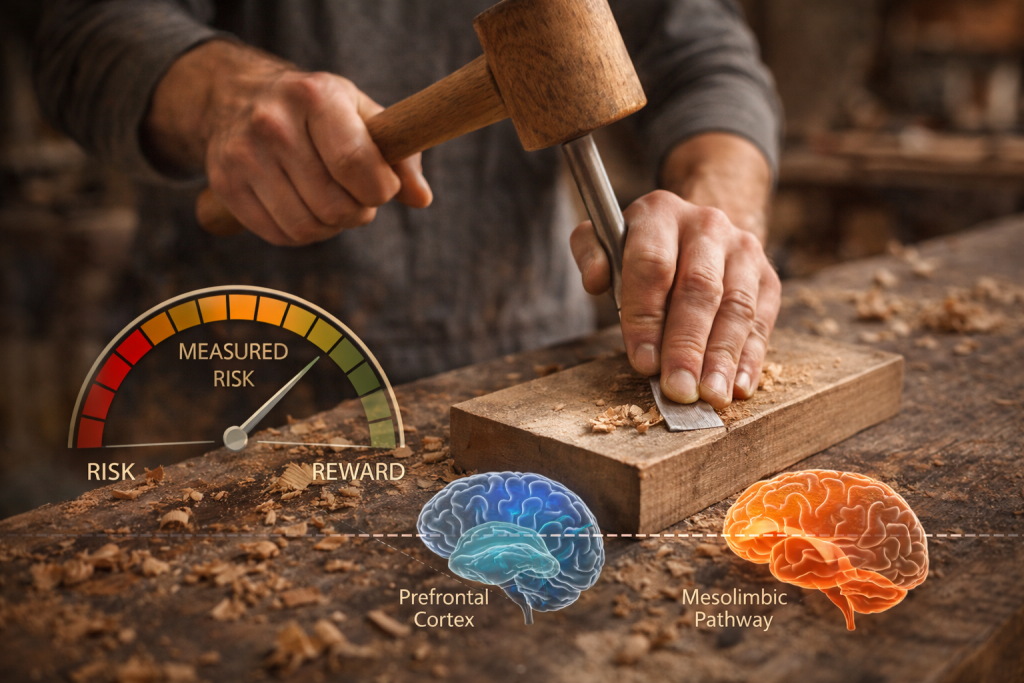
Growth requires manageable risk. Too much risk triggers shutdown. Too little produces boredom. The optimal zone is what psychologists call the “window of tolerance.”
Working with hand tools—whether carving knives, chisels, or precision brushes—places individuals in that optimal zone when instruction is structured properly. There is enough challenge to demand attention. There is enough safety structure to prevent overwhelm.
Using tools requires planning, coordination, and accountability. A tool responds directly to input. If pressure is uneven, the result reflects it. This feedback loop is immediate and honest. Cognitive-behavioral models highlight the importance of feedback in skill acquisition; accurate feedback accelerates learning and builds adaptive response.
At Ironwood, participants are taught tool literacy. They learn not only how to use tools but how to respect them. This fosters responsibility and internal locus of control. Instead of externalizing outcomes (“This isn’t working”), the participant adjusts technique (“My angle is off”).
This shift from external blame to internal adjustment builds psychological resilience.
There is also a physiological component. Novel but controlled challenge releases dopamine in moderate amounts. Dopamine is associated with motivation and reinforcement learning. When a person successfully completes a challenging task, the brain encodes it as rewarding.
Over time, participants begin associating effort with positive reinforcement rather than fear of failure.
Measured risk builds courage in increments. Ironwood’s teaching philosophy recognizes that confidence is not taught through affirmation. It is built through earned mastery in controlled environments.
Modern life rewards speed, novelty, and reaction. The nervous system, however, stabilizes through rhythm and repetition.
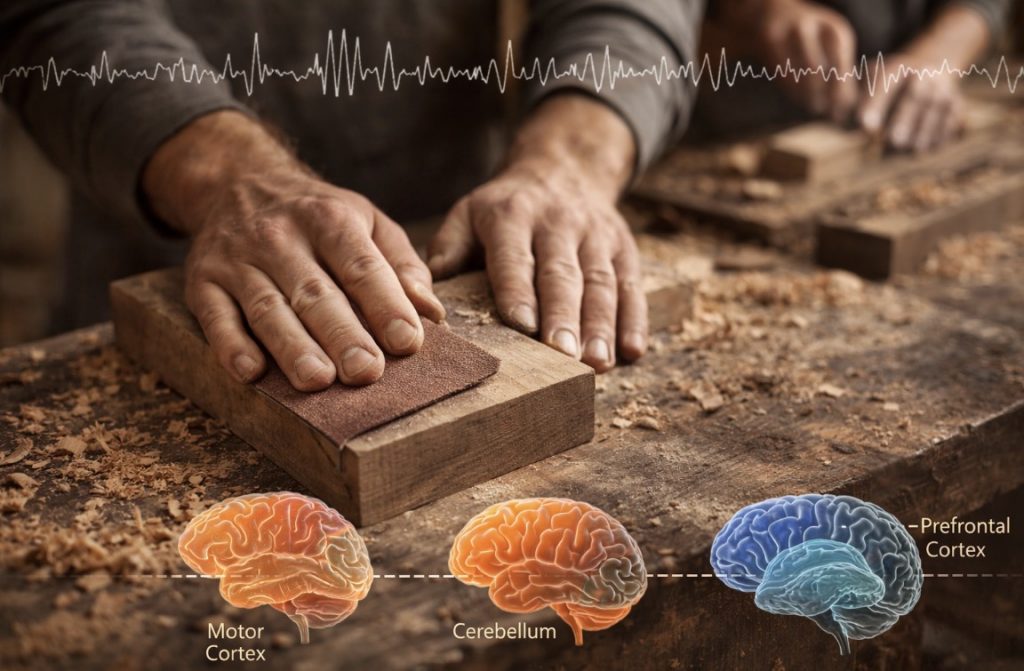
One of the foundational teachings at Ironwood Collective is that repetition is not mindless—it is regulatory. When a person sands the same surface in controlled strokes, traces the same line carefully with a carving tool, or measures and cuts with precision, they are engaging in patterned motor activity. Patterned motor activity has a stabilizing effect on the autonomic nervous system.
From a neurological perspective, repetitive fine-motor engagement recruits the cerebellum and motor cortex in synchronized coordination. At the same time, sustained attention activates the prefrontal cortex. When attention remains anchored to a structured task, activity in the default mode network—the network associated with rumination and self-referential thinking—tends to decrease.
In practical terms, the brain has less bandwidth for spiraling thought when it is tracking pressure, angle, and movement.
Repetition also builds predictability. Predictability lowers perceived threat. When the brain can anticipate the next movement, it signals safety. Safety cues reduce sympathetic nervous system activation (fight-or-flight) and allow parasympathetic processes (rest-and-regulate) to come online.
At Ironwood, repetition is not filler. It is intentional. Participants are taught that the purpose of repeating a motion is not only to refine skill but to train steadiness. The lesson becomes internal: stability is built, not found.
Over time, repeated effort produces visible progress. That visible progress strengthens self-efficacy. Research in behavioral psychology consistently shows that competence develops through repeated successful completion of manageable tasks. The brain encodes these experiences as evidence: “I can begin something and see it through.”
For individuals who have experienced chronic stress or instability, this message is corrective. The nervous system learns that effort does not lead to chaos. It leads to measurable outcome.
Repetition is often undervalued in modern culture. At Ironwood, it is the core method
The idea behind Ironwood Collective did not come from a trend. It came from observing something consistent: when people work with their hands in a structured way, something shifts.
Breathing slows. Attention narrows. The nervous system settles.
For years, I noticed that deliberate, repetitive handcraft—woodworking, carving, sanding, shaping—produced a level of focus and internal steadiness that felt different from distraction. It wasn’t escapism. It was regulation.
Ironwood Collective was built around that principle.
Why Working With Your Hands Changes the Brain
Neuroscience supports what craftspeople have known for generations. The human brain is deeply wired for sensorimotor integration—the coordination between movement and sensory input. When we engage in precise, repetitive hand movements, several systems activate simultaneously:
• The motor cortex (movement planning and execution)
• The somatosensory cortex (touch and tactile feedback)
• The cerebellum (fine motor control and timing)
• The prefrontal cortex (attention and executive function)
When these systems engage together in a focused task, cognitive rumination decreases. This is similar to what psychologist Mihaly Csikszentmihalyi described as “flow state”—a condition in which skill level and challenge are appropriately matched, producing deep immersion and reduced self-referential thought.
Additionally, tactile engagement stimulates mechanoreceptors in the skin. These receptors send signals that can downshift sympathetic nervous system activation (the “fight or flight” response) and increase parasympathetic tone (the “rest and regulate” state). Slow, repetitive movement combined with tactile feedback can measurably reduce physiological stress markers.
Ironwood is not unstructured crafting. It is structured handcraft.
Structure matters.
Psychologically, predictability reduces threat perception. When a person engages in a task with clear steps, defined tools, and measurable progress, the brain experiences control and completion. These experiences strengthen self-efficacy—the belief that “I can do hard things and see them through.”
Repeated completion of small, controlled tasks builds confidence more reliably than motivational language ever will.
This is especially relevant in environments where people feel destabilized by external uncertainty. Stability cannot always be found outside. It can, however, be built internally through repeated experiences of effort and earned achievement.
Why Sensory Work Is Different From Passive Relaxation
Passive coping strategies—scrolling, watching, consuming—do not require motor planning, tactile feedback, or skill development. They distract, but they do not build capacity.
Working with your hands demands presence. If your attention drifts while carving, sanding, or shaping, the material reflects it immediately. The feedback is real and immediate.
That loop—action, feedback, adjustment—strengthens cognitive flexibility and emotional regulation. It trains the brain to tolerate minor mistakes without catastrophic interpretation. It teaches correction without collapse.
In psychological terms, this builds distress tolerance and frustration resilience.
Where Ironwood Came From
Ironwood Collective developed from lived experience with structured repetition as a stabilizing force. I started Ironwood Collective after years of surviving domestic violence, when I began to understand how deeply chronic stress imprints on the nervous system.
Structured handcraft became a way to rebuild internal stability through repetition, focus, and earned competence when so much of life had felt unpredictable and unsafe. Over time, it became clear that what felt personally regulating was not unique. It was physiological and cognitive.
The program was built intentionally around three principles:
Structured Craft.
Sustained Effort.
Earned Achievement.
The emphasis is not on aesthetic perfection. It is on the process: precise repetition, measurable progress, and the quiet confidence that emerges from finishing something tangible.
The wood does not respond to emotion. It responds to pressure, angle, and consistency. That neutrality is powerful. It creates an environment where effort—not personality, not performance—determines outcome.